How Emertech Enabled Apollo Tyres’ EUDR Compliance

From Rubber Plots to EU Filings: How Emertech Built Apollo Tyres’ EUDR Compliance System
EUDR requires a high degree of transparency and traceability across the natural rubber supply chain. Our collaboration with Emertech Innovations has enabled us to bring together sourcing, traceability and geospatial validation capabilities at scale, covering a significant natural rubber sourcing footprint. This implementation strengthens our ability to establish end-to-end visibility from source to finished product and supports our continued commitment to responsible and compliant supply chains.
Shibu George, Group Head- Advanced Mfg & Enterprise Application, Apollo Tyres Ltd
Emertech Innovations worked with Apollo Tyres to bring its EUDR responsibilities into one connected compliance system: From collecting source-plot information to filing Due Diligence Statements through Apollo’s European operations.
At a glance
-
Client: Apollo Tyres
-
Supply base: Natural rubber from a large and diverse supplier network spanning India and several international markets
-
Regulation: EU Deforestation Regulation (EUDR)
-
Scope: Supplier engagement, geolocation validation, deforestation-risk analysis, ERP-linked traceability and Due Diligence Statement filing via TRACES NT
-
Outcome: Continuity: Natural rubber followed from its source plots through production to the relevant EU shipment
EUDR compliance at scale
The implementation currently brings together a substantial natural rubber sourcing footprint:

The challenge: A strong supply chain, A complex obligation
Apollo Tyres sources natural rubber through a large and diverse supplier network spanning India and several international markets. That network makes its supply chain strong. Under the EU Deforestation Regulation (EUDR), it also makes compliance considerably more complex.
EUDR requires companies to:
-
Origin: Know where their natural rubber originated
-
Deforestation: Establish that the source plots are free from deforestation after the regulatory cut-off date
-
Traceability: Maintain traceability as the material moves through production
For relevant EU shipments, this information must ultimately support a Due Diligence Statement filed through the EU Information System.
The solution: One connected system, in five stages
The system connects five stages, each building on the one before, with an administrative portal that gives Apollo’s teams one view across all of them.
-
Engage: A supplier portal for GeoJSON files, sourcing information, risk evidence and supporting documents
-
Validate: Every submission checked against EUDR geolocation requirements
-
Assess: Satellite-based deforestation analysis, with a risk result report for every plot
-
Trace: ERP-linked chain of custody, from purchase order to export shipment
-
File: Due Diligence Statements filed with the EU Information System via TRACES NT
Administrative portal: One view across every stage for compliance, procurement and operational teams.
Stages 1 and 2 – Engage and validate: Reliable data, right from the source
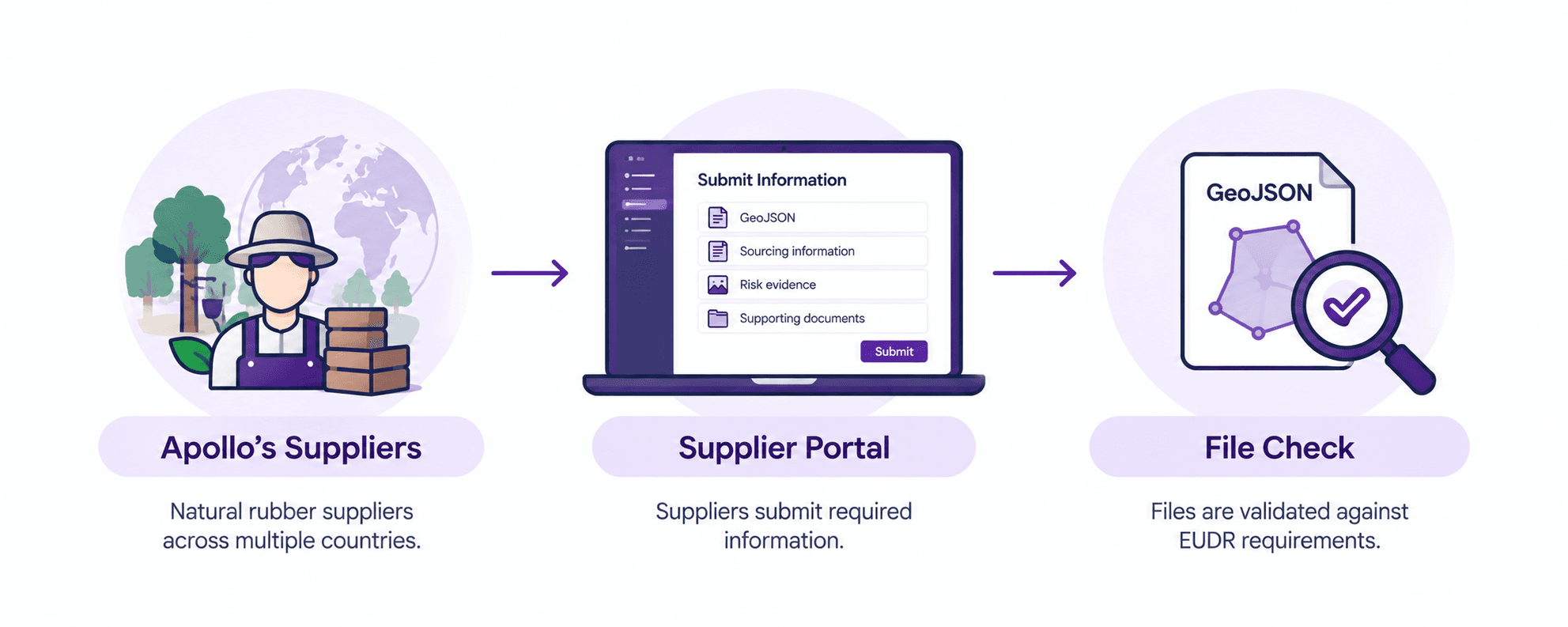
Reliable EUDR compliance begins with reliable supplier information.
Engage
Apollo works with natural rubber suppliers across multiple countries, with varying levels of digital readiness. Emertech developed a dedicated supplier portal that gives each supplier a structured way to submit GeoJSON files, sourcing information, risk evidence and supporting documents.
Validate
Collecting a GeoJSON file is only the first step. The file must also accurately represent the source plot and meet the applicable EUDR geolocation requirements. Emertech’s platform therefore checks each submission for:
-
File structure
-
Coordinates
-
Geometry
-
Mandatory plot information
-
Correct use of points or polygons
It also identifies issues such as:
-
Malformed boundaries
-
Duplicate plots
-
Potentially overlapping submissions
What it gives Apollo: A central view of what has been submitted, what is incomplete and what requires further attention.
What it gives suppliers: A clear route for sharing the information required to support EUDR due diligence.
Stage 3 – Assess: looking beyond the coordinates

A technically valid GeoJSON file confirms where a plot is located. It does not, on its own, establish whether deforestation has occurred there.
This is where Emertech’s capability aims to add the next layer of intelligence. Its satellite-based deforestation analysis, DART, examines the land enclosed within a supplier’s submitted plot boundary and compares historical satellite imagery with current forest-cover and land-use information. In simple terms, it helps answer the question at the heart of EUDR:
Does the available evidence indicate that this plot was affected by deforestation or forest degradation after 31 December 2020?
DART provides a clear, evidence-backed risk result for every plot. Potentially risky plots are flagged and held for review before entering the compliant supply chain.
What it gives Apollo: Concerns are identified at the source, before the associated natural rubber becomes part of production or an EU-bound shipment.
Stage 4 – Trace: connecting plots to the flow of material
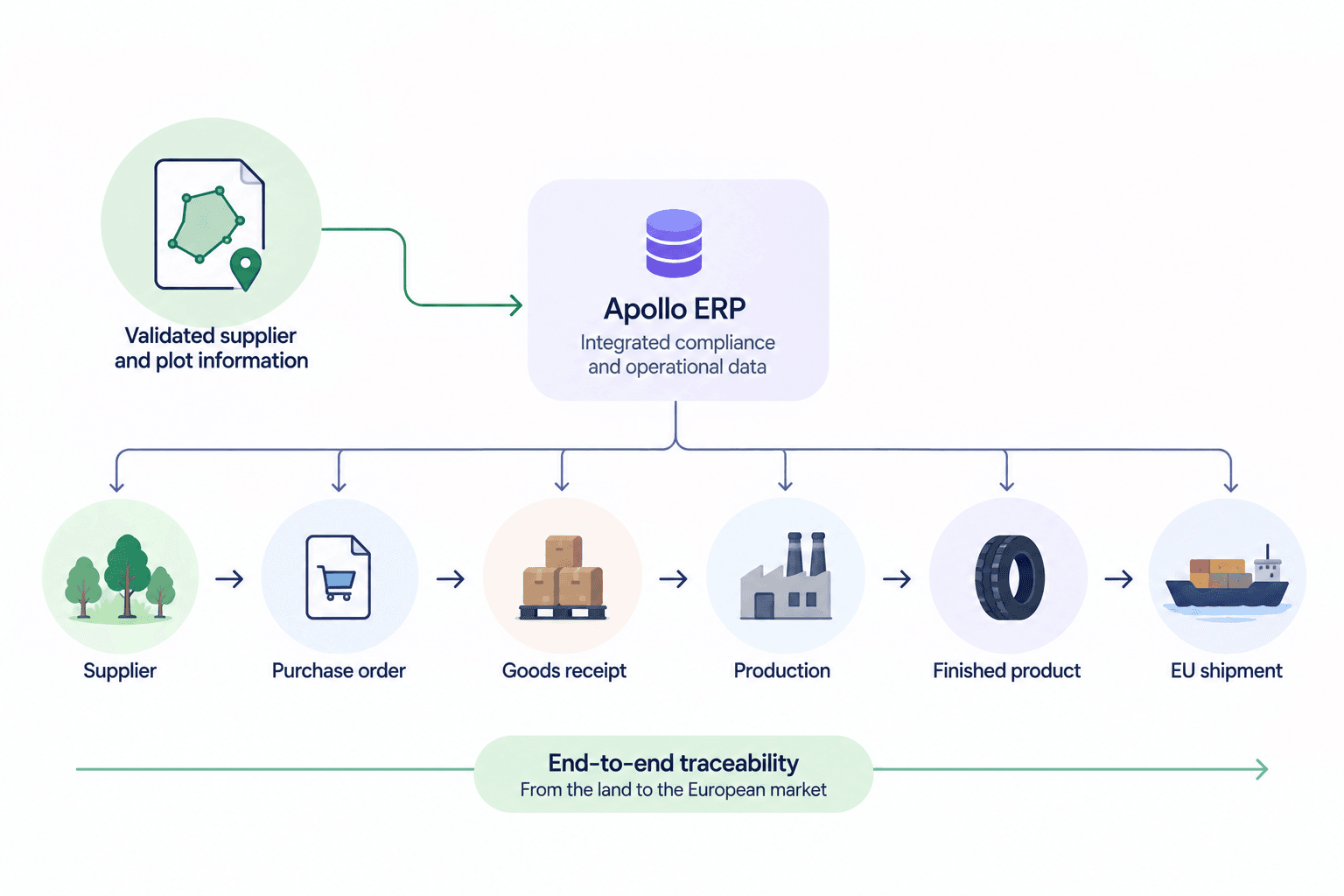
Supplier and plot information becomes genuinely useful only when it can be connected with the way material moves through the business.
Emertech integrated the compliance system with Apollo’s existing ERP and operational environment. Validated supplier and plot information can therefore be linked with:
-
Purchase orders
-
Incoming consignments
-
Goods receipts
-
Material and batch records
-
Production transactions
-
Finished products
-
Export shipments
This creates an unbroken connection from the land where the rubber originated to the product eventually placed on the European market.
What it gives Apollo: EUDR is not handled as a separate exercise at the end of an export process. The necessary traceability is built into the journey of the material itself.
Stage 5 – File: from Apollo’s systems to the EU Information System
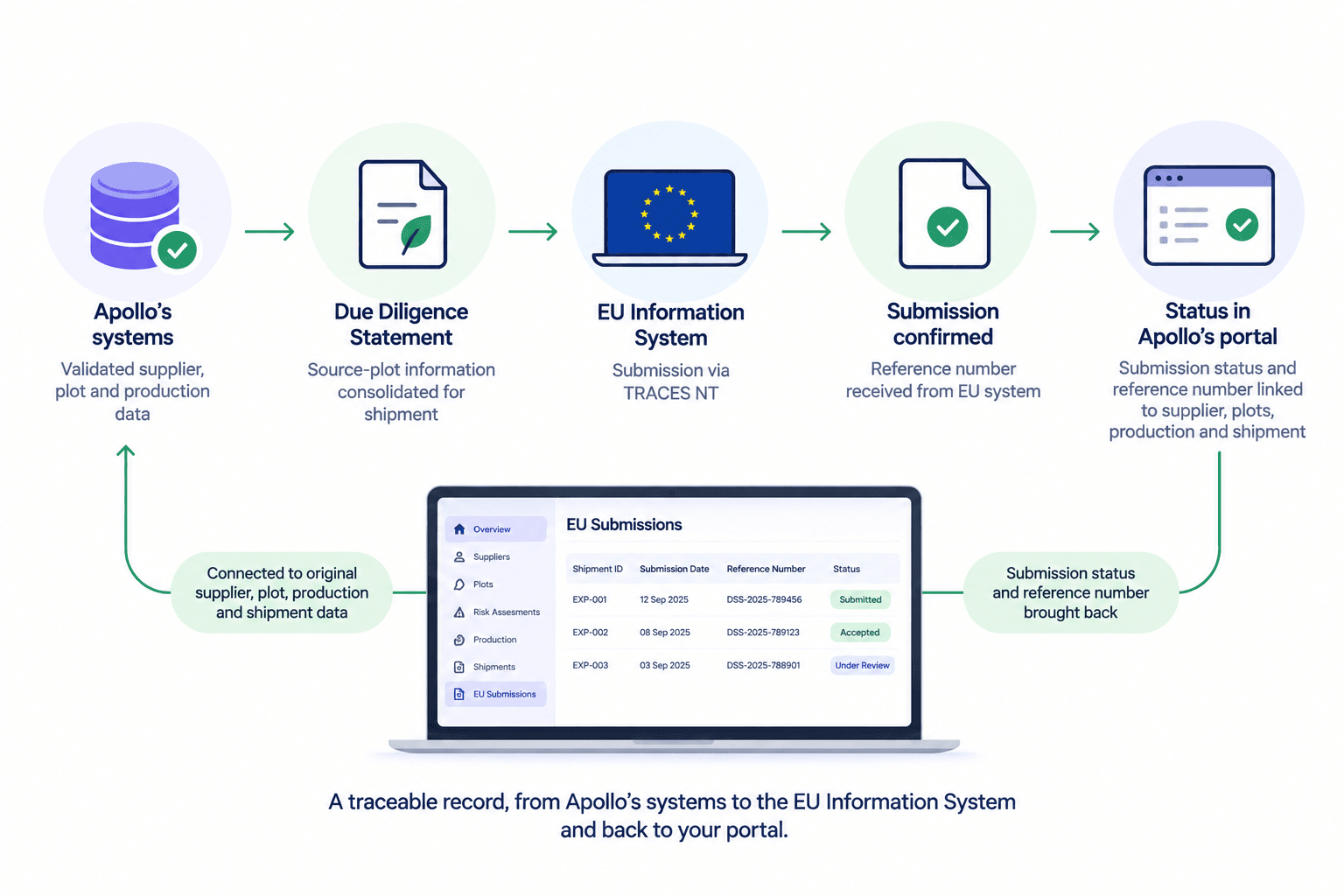
Due Diligence Statements move from Apollo’s systems to the EU Information System via TRACES NT, with status returned to Apollo’s portal.
The final stage of the process takes place through Apollo’s European operations.
Emertech integrated the solution with the EU Information System within the TRACES NT environment. For a shipment, filing runs in four steps:
-
Consolidate the applicable source-plot information for the shipment.
-
Use it to prepare the relevant Due Diligence Statement.
-
File the statement directly with the EU system.
-
Bring the submission status and reference number back into Apollo’s administrative portal.
This keeps the regulatory filing connected to the suppliers, plots, risk evidence, production records and shipment on which it was based.
What it gives Apollo: Not simply a submitted declaration but a traceable record showing the evidence behind it.
Across every stage: one view of compliance

Emertech also facilitated a centralized administrative portal for Apollo’s compliance, procurement and operational teams.
The portal brings together:
-
Supplier submissions
-
GeoJSON validation results
-
Plot-level risk assessments
-
Supporting evidence
-
Flagged plots
-
Production traceability
-
Due Diligence Statements
Instead of viewing each part of EUDR in isolation, authorized teams can see how the information connects, from the supplier that submitted a plot to the finished product and shipment supported by that plot.
What it gives Apollo: This shared visibility is particularly important when an issue requires review. Teams can identify where the concern originated, examine the available evidence and prevent the affected plot from progressing until the matter has been addressed.
The result: Continuity, from source plot to EU shipment
The most important outcome of the implementation is continuity.
Supplier information does not remain in one portal while production data sits in another system and regulatory submissions are managed separately. Each stage is connected, allowing Apollo to follow natural rubber from its source plots through production and onward to the relevant EU shipment.
Emertech’s work with Apollo Tyres demonstrates what enterprise EUDR readiness looks like in practice, with five capabilities working as parts of the same system:
-
Structured supplier engagement
-
Validated geolocation data
-
Understandable deforestation-risk evidence
-
ERP-linked chain-of-custody traceability
-
Direct regulatory filing
For a multi-country natural rubber supply chain, that connection is what turns EUDR from a reporting obligation into an operational compliance process.
Preparing your supply chain for EUDR?
Emertech helps enterprises connect supplier data, geolocation validation, deforestation-risk assessment, supply-chain traceability and TRACES NT filing in one compliance workflow.
Talk to us about building EUDR compliance into your supply chain.
Reach us at : info@emertech.io
Visit us at: https://emertech.io/EUDR